
Insights
The retail tech trends shaping the
warehouse of the future

3 min read
72% of retailers with 250+ employees believe legacy tech is hindering their ability to operate efficiently.¹
As online sales, costs and efficiency pressures have increased over the years, so has the need for more automated, efficient warehousing. Selecting the right technology and implementation partners is critical for future success.
Adopting new technology to deliver efficiencies is a challenge for retailers. Old or outdated equipment can be expensive to replace all at once, so it's often a gradual process to modernise.
44% of retailers believe upgrading or improving their legacy tech will help them automate processes.¹
- They’re investing heavily to make sure:
- They keep operational costs down
- They can quickly process and track orders and returns
- They can maintain optimum stock levels
- Their staff can focus on the work that matters most
So what will the warehouse of the future look like?
The robots are coming
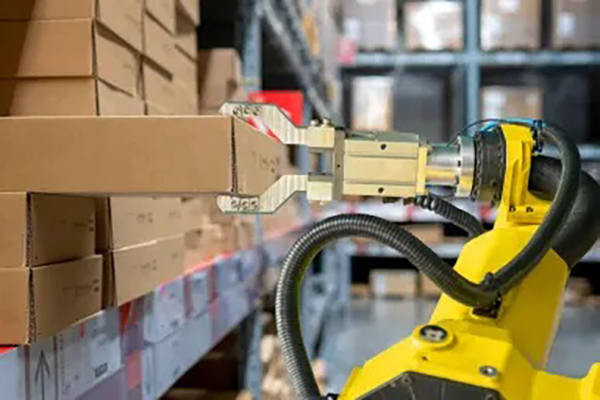
The retail warehouse of the future will be highly automated, using robotics, artificial intelligence (AI) and internet of things (IoT) sensors to drive efficiencies.
For example, Next have implemented a solution called AutoPocket to bring sorting and sequencing efficiencies to their new warehouse. This optimises processes and reduces the time needed for processing customer orders.⁴
The sight of autonomous robots picking, moving and packing orders will also become increasingly common.
Geek+ robots already help retail giant Walmart handle its massive quantity of items, improving its picking efficiency by about 3.5 times.²
And Ocado’s automated warehouses are some of the largest and most sophisticated in the world. They feature thousands of bots working like a swarm across a giant grid, at speeds of up to four metres a second to pick a 50-item order in a matter of minutes.³
Autonomous robots will become more prevalent across all aspects of the supply chain. While current automated guided vehicles (AGVs) follow fixed paths, autonomous mobile robots (AMRs) are able to move independently, performing repetitive or dangerous jobs.
When humans do need to get involved, wearable devices and augmented reality can support their tasks. Robotic exoskeletons can even be used to help with heavy lifting.
In addition to advances in robotics, the warehouse of the future will see AI powering increasingly accurate demand forecasting and warehouse optimisation. It will also be able to check for human errors, theft and safety issues.
We’ll also see an increase in IoT sensors embedded within the warehouse environment, helping with inventory management, equipment monitoring and predictive maintenance. IoT devices will also facilitate digital twins of the warehouse, which can be used for testing operational changes and user training.
Knowing where your products are will still be the key to an efficient supply chain.
As the cost of radio frequency identification (RFID) tags drop, we'll see their use become more widespread across the whole of the supply chain. Combined with temperature, impact and other specialised sensors, RFID will monitor the condition and location of products in transit. This will help ensure product quality and traceability requirements are met.
Such new technologies will enhance speed, accuracy and overall efficiency in the order fulfilment processes.
Bringing our A game
The adoption of new tech will bring an exponential increase in the number of connected warehouse devices. In addition, retailers need to gather real-time data and insight along every part of the retail supply chain to ensure smooth operation. There is a real need for lightning-quick connectivity and ultra-low latency across the network.
As advanced technology is deployed more widely, it’s not advisable to have all your devices hanging off your Wifi. It’s going to start creaking.
5G private networks can help with such evolving needs. Superfast internet speeds, ultra-low latency, high reliability and enhanced data security are all part of the package and mean business-critical applications do not need to communicate to an application in the public cloud.
Bridging the skills gap
Investing in new technology is a start, but there’s still plenty of work to be done to embed it into your warehouse and realise the improved organisational processes.
User resistance and limited digital skills are some of the key obstacles you’ll need to overcome.
With a wide array of IT requirements and demands including connectivity, collaboration tools and security, retailers are turning to external IT support.
63% of retailers rely on a mix of internal and external IT support or external IT support only.1 This can be anything from selection, buying and installation of IT equipment to maintenance and even full IT management.
74% of retailers agree that their IT and telecoms provider gives their organisation the support they need to maximise the efficiency of their current tech equipment and solutions. That’s a huge vote of confidence.
As customers and partners work together more often and achieve greater success, overcoming problems becomes a shared objective.
We pride ourselves on our in-house expertise and have strong partnerships with technology providers. We help retailers harness technology to achieve long-term goals, remove blockers and explore new opportunities. For more insights and practical guidance, visit our Retail Hub — your destination for driving operational efficiency and building future-ready retail solutions.
1 Retail Tech Untapped report 2023
2 Geekplus.com
3 Ocado Group

Meet Head of Retail:
Fiona Dew
Helping retailers embrace new technologies and innovations that help increase efficiency, productivity and reimagine customer experiences, all made possible by greater connectivity.
Reset your expectations with a new type of partnership
Book a free consultation, where you can learn more about how we can help you optimise your IT spend and reach your goals.
Ask us about our Success Agreements and IT audits, and let’s write the next chapter of retail together.
Get in touch
After submitting this form, you will get to hear about all the great stuff we’re doing by email or phone as your details will be added to the Virgin Media O2 Business marketing database. You can opt-out of receiving communications any time by visiting the Virgin Media Business and O2 business landing page here.
©2024 Telefonica UK Limited.
All Rights Reserved
Telefonica UK Ltd is authorised and regulated by the Financial Conduct Authority (reference number 202222) and Virgin Media is an appointed representative of Telefonica UK Ltd.
©2024 Virgin Media.
All Rights Reserved
For Virgin Mobile only, Virgin Media is an appointed representative of Virgin Media mobile finance which is authorised and regulated by the Financial Conduct Authority